
Bone Grafting Hasn’t Kept Pace with Modern Surgery
Surgeons still rely on imperfect solutions to repair bone defects, each with significant trade-offs for patients and clinicians.
Autografts – Effective, but Invasive
Require harvesting bone from the patient’s own body, creating a second surgical site, increasing pain and complications, and limiting available bone.
Allografts & Xenografts – Available, but Not Ideal
Human donor bone is limited, while animal-derived bone is more abundant. Both require extensive processing and may not integrate or remodel like the patient’s own bone.
Synthetic Substitutes – Convenient, but Unadaptable
Conventional granules lack structural integrity and defect-specific geometry, making placement challenging and offering limited control over degradation and bone regeneration.
Membranes – A Trade-off Between Handling and Protection
Collagen membranes can be difficult to handle, position, and suture. Non-resorbable membranes, such as titanium mesh or PTFE, may require removal and carry risks of exposure, wound complications, and infection.
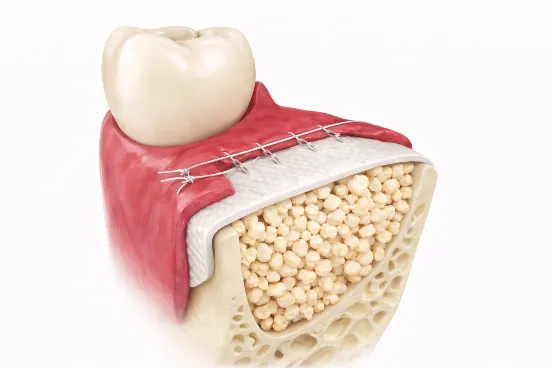
From Scaffold to Bone in Three Steps
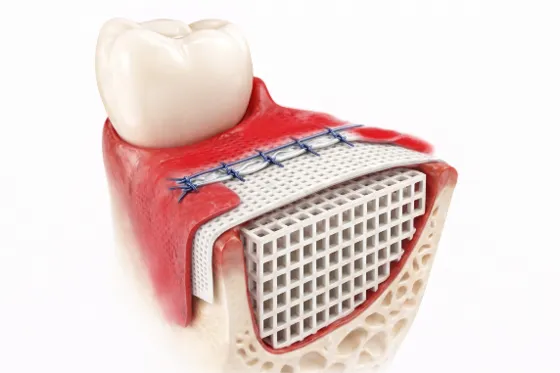
We combine patented smart designs with advanced regenerative biomaterials to create 3D-printed, porous, resorbable scaffolds and membranes engineered to support new bone formation and gradually be replaced by the body’s own tissue.
Shape
Designed for surgical simplicity, our scaffolds and membranes can be easily trimmed with a blade or scissors to match the defect.
Fit
Our products can be securely positioned using sutures, tacks, or pins, helping surgeons achieve a precise fit and streamline surgical workflows.
Heal
Once implanted, the scaffold provides immediate structural support while guiding new tissue formation throughout its porous architecture. As healing progresses, the material gradually resorbs, creating space for tissues to regenerate.
Our Products
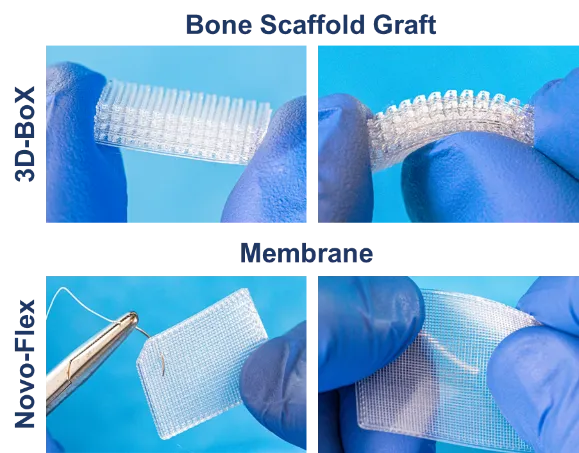
3D-BoX scaffold bone graft
The scaffold is designed for direct, one-step insertion into the bone defects. It is engineered with large pores to support vascularized bone ingrowth while maintaining the horizontal and vertical dimensions of the bone.
Novo-Flex membrane
Combines smaller pores with elastic properties to help prevent soft tissue invasion while permitting nutrient diffusion and supporting the biological processes required for regeneration. In addition to the standard membrane size, NovoFlex is available in large sizes for challenging cases, covering defects larger than 3 cm.